Showing posts with label Children. Show all posts

Wednesday, August 3, 2016

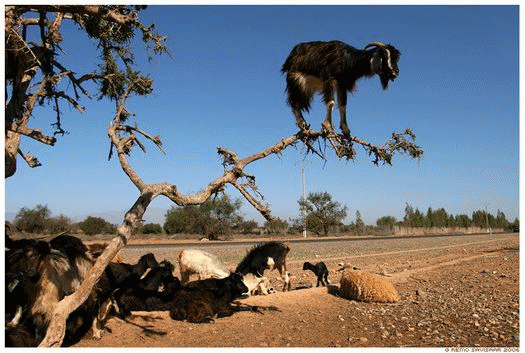
The dynamics of going out on a limb

Image Source: Freqmix.wordpress.com
People fail at staying with challenges all the time. I see myself and others giving up on challenges once we hit an obstacle, or there is a setback.  We either say been-there-done-that all too soon and dust our hands, or we struggle against a thick wall, the kind fortresses have.  I was trying to investigate this staying with a challenge in the context of a couple of recent challenges that I have been facing / have given myself. And wondering, what constitutes staying with the challenge, what constitutes "success" and what constitutes "failure".  For instance, if I have resolved to stick to a particular habit, and I don't do it on the second day itself, does this mean I have failed? And I restart again the next day.  What if I "succeed" now, and keep to the habit for 6 months and then it goes for a toss on my next round of travelling? Different permutations and combinations of successes and failures have happened in this realm by now, and this dichotomous way of working with a challenge fails to move me.  Plus I find that it is very limiting and not useful at all in understanding a situation / a challenge, all the elements of given instance, and oneself, realistically. What I do know is that it is Hard, staying with a challenge.

Staying.  Present continuous.  What if I looked at this as a continuous process, something to be worked upon constantly, and it is constantly changing? A work-in-progress.  There is no arriving at a destination.  There is no one point to be reached.  Looking not at the challenge as a goal to be reached, but at the staying with the challenge as a direction of movement, changes the perspective drastically and opens out many possibilities of working with it.  The shift in perception widened the canvas for me and I started noticing the nuances and details of how challenges manifest, how we define challenges and so on.  

What stands out for me is what I first saw in two very different phenomena, both of which exhibited similar forces at play, in working a challenge.  And then I could stretch my imagination and see the same forces at play everywhere. One phenomenon is the way in which children in general, and in particular reference my daughter, take risks and challenge themselves.  The second is my asana and pranayama practice, and what I have learnt from a couple of my elders, about stretching oneself to attain a posture.  

The forces at play are, one, an anchoring and two, a stretching.  The dance between these two, the balancing act of these forces (if we can manage it) is the dynamics of going out on a limb.  There is something(s) that is constant, the anchor, the grounding.  There are things that are changing, that are exploring, that are new, that are the risks, the new avenues.  I need both forces to stay with a challenge, and keep going out on that limb.  Most of the time we are caught with one force or the other, and do not even know that we need to hold both together.  Our education and our conditioning teaches us to stand polarised and negate the other force.  However, deeper truths can emerge only when we hold both ends together.  

On one end we are so stuck to our comfort zones, so enmeshed in our own complacent worlds, that we don't want to step out at all, We dont want the discomforts of challenges, and dont take risks.  We dont want the discomfort of getting up early in the morning, for instance, or we dont want the discomfort of giving up a pleasing hobby to pursue a passion and let it stagnate. We allow what could be an active, life-giving and nourishing anchor, the ground on which we grow, to become a cesspool, the "dreary desert sand of dead habit" in the words of Rabindranath Tagore. 

On the other end, we are so taken up with the new, that we follow its glitter as it beckons to us and compromise stable ground.  We follow where are feet and eyes take us, and dont pause for conscious choice.  We have such luxury of options today that we no longer know the Ahimsa and the contentment of limited choice.  We can shop for anything we want and explore all that the world has to offer and become compulsive consumers, instead of tapping into the true and deeper seeking / enlivening pursuit that man is capable of, and I believe, is born for.  To go out on a limb and find one's true purpose.  We lose this. 

Children seem to hold these two forces together with such dexterity while playing (but then they also seem to be playing ALL the time! Sigh!).  They take risks, they jump off tables, they walk into crowds and get lost, they take apart things and try to put them back together ruthlessly sometimes.  They are spontaneous, irreverent even and completely un-self-conscious with language, muddling into communication like a bull in a china shop, which however gives them enormous ability to grasp 5-6 languages in the formative years.  This is their seeking force.  While doing all this, they time and again, check back with their primary care takers, their family.  My daughter's trust is implicit, unconditional and absolute, that I or her father will catch her when she jumps off the counter. Her anchor, ground.  When she walks into a crowd, she is sure that I am keeping her in my sight (which every parent would strive to do!).  This is one anchoring for them in their early years.  You can also notice how they form other anchors as they grow.  We are not here talking of mistakes that human anchors may make and so on.  We are here talking of how children hold these two forces together, and for me this is a great learning.  How can I take care of my anchoring, find and nourish my constants in such a way that I can trust these implicitly and absolutely to hold me, when I jump off the cliff, or dive into the ocean.  Such that my anchors do not weigh me down into comfortable habits and yet do not let go off me such that I get carried away by the wind.  

Similarly, in asana and pranayama practice, I will need to stretch and twist and fold down and arch back in order for me to attain new postures, that give me greater strength and flexibility and understanding of my self and allow me to sit longer for meditative practices.   My breath is one of my primary anchors here (there can be others).  And one of my constant quests in my personal practice is to see how I can work with the stretching (the seeking and exploring force) such that it feeds into my constants, like tributaries flowing into the river.  

There is no question of 'failing' at challenges or not being able to go out on a limb, when we can bring into dynamic action, these forces at play.  It is a matter of tapping into these forces inside of us.  And this is a life-long process.  I mean, its not just one limb that you want to go out on, right? ;)  


Tuesday, August 2, 2016

The Importance of Role Playing

I started out thinking how important role play is in a child's life. This has been a constant experience and exploration for some time now because my daughter (who is nearly 5 years old now) cannot let an hour go by without engaging in some sort of a role play game / activity. 

She plays "Housing" with her friend, wherein she is the mother, and A, her friend, is the father, and they together make and keep a home, filling it with all the activities that they see their adults do. 


She plays with her dolls, assigning them different characters and enacts stories / scenarios of her own making. (She has a weird variety of soft toys that includes a dinosaur, frog, rat, elephant, dog, reindeer, rabbit, rag dolls, and of course, a couple of teddy bears. None of which we bought!)

She dances to music and at various times, with different kinds of music, assumes different characters and roles. 


She masquerades as a mother, to a little red doll that she carries around.  She feeds it, sometimes from a bottle, or from her hand, sometimes breastfeeds it; plays with it, puts it to bed, scolds it, cuddles it, gives it a bath, combs its hair and is oh-so-protective.  Then suddenly she throws it up in the air, and when I look at her with shock, she says, "Amma, it's a doll, a non-living thing, and I am K! okay?" Oops! Okay. 

She talks to her imaginary friends.  These are sometimes created out of her imagination, are characters from the stories she hears at other times, and at times real-time friends or family or relatives, but who are imagined to be there at that point. 


This list can go on for pages.  Her latest favourite is that she is our dog's wife and she goes about on all fours, woofs at him, howls at the sky, nudges and rubs against him, and then gets up to announce that she is his wife. 


I was seeing, enjoying and experiencing with delight what I have known in theory and seen glimpses of.  That children process so much of their lives, their emotions, their joys and insecurities and so on through their role playing. I was seeing how formative and vital these stories and role play are to her image of herself and the world around her.  She is building stories about herself, about the people around her, about things, and all the emerging relationships.  

What followed this initial delight was also a lot of conflict, guilt many times, much joy of course, and also intense struggle for me.  Sometimes I would pick up a fear that I was sensing, some other time it would be a want or need.  Once she clearly communicated through her mother play that she felt I had no business doing some particular activity.  I felt completely in quandary about what I should do with all this rich data that I was receiving. I would sift through many options and try to see how am I to use what she just expressed , to do the right thing. And I sank deeper and deeper into this quicksand of action. 


And then it all fell into place as I started writing this piece. Role playing is important, not just for a child, for my daughter.  It is as, or more important, for adults, for me.  True that we discover, and develop if allowed to, this art / skill when we are children.  But it is so vital to nourish this and even "use" it perhaps as adults as well, in order for us to process our emotions and gain stable ground. I recognised that along with her, I had also been engaging in all the role playing, until I started analysing it and trying to use it. I had been feeling, experiencing, enacting, myriad things right along with her through the stories and the playing. And much was happening in the play.  So much healing.  So many stories were getting told.  Old ones discarded, new ones born, Old ones re-told.  New understandings. Insights.  Emotions were filling us and then draining away.  Without us getting drained in this process.  It was all happening in the lyrical and mystical language of stories and role playing.  It can continue to do so.  I don't have to "do" anything about it.  I am simply going to sit back and enjoy the ride! 

Saturday, February 28, 2015

Of Listening and Self Discipline

This is a corollary and continuation to the Introduction of this blog.  To summarise the introduction: everybody wants to have their say, and the vast ocean of personal blogs in the world wide web seems to be expressing the same desire; however, who is truly listening, to understand and engage in a meaningful way?

Let's go further now, and ask, what if one was truly listening, just to listen?  Listening for the purpose of listening.  What does that mean?  That there is no agenda or purpose for the listening, save for that of listening.  There is no purpose (not even to understand and engage, so there truly is NO purpose except this moment's act of listening) - what happens then?  There will first probably be no inspiration to rush in to say anything to the other by way of advice or opinions or thoughts or comments or suggestions.


When can there be no other agenda except that of listening?  There actually seems to be no sphere of everyday human functioning where this listening is happening consciously.  There are of course special circumstances when this may be taking place (or at least the intention for this type of listening is present).  One obvious circumstance is that of counseling and psychotherapy besides other specific groups and spaces which may be looking at such a way of engagement, perhaps as part of a larger exploration of living meaningfully.

So when can there be no motivation to change the other through advice and comments and reactions and responses?  For if we examine with care, we will see that all our advice to others is almost always in the realm of changing and reforming the other.  We want to change them such that they can see the light, the same as we are.  The way they are seeing it and / or not seeing it, and / or seeing darkness, and / or something else entirely, are situations somehow not acceptable to us.  And it is not acceptable to us, because each of us have our frames of reference and contexts that we think from, and have already decided that our ways of thinking and doing are right and the other wrong and thus pass judgment and give labels.  I am also acutely aware that there is a huge jump in the earlier sentence and there are a lot of steps to be taken before we get to this point in the inquiry.  Also, the passing of judgment is not necessarily with vicious intent or even emphatically stated; it is part of the conditioning that we pick up and internalise consciously and unconsciously through culture, society, our parents first, then extended family, teachers, friends, and so on. For instance, "Don't cry like a girl" is an oft repeated statement, and this may be defended by saying that it is just a casual comment and / or said lightheartedly. However, we need to stay with the statement and see why it is even there. This is simply one example of how judgments are present in everything we choose to think, do, not think, not do and so on.  An important aspect to consider is that these insidious judgments are turned on ourselves also - that is, when I have a judgment about another person, it is for sure that I have that judgment on myself.  And this will work in such hidden ways and manifest as convoluted knots that would leave one stupefied and sometimes wondering, "What the hell was I thinking, doing such and such a thing?!".   To give a simplistic example, if I carried the above judgment, "dont cry like a girl", I may then be someone who would hate to cry . And hence, every time I feel like crying I would judge myself to be a wimp (just like a girl - a whammy there: crying is wrong / wimpy, girls cry, girls are wrong / wimpy), and try to suppress it. Either I succeed in suppressing it all the time, and like a pressure cooker, its going to burst some place some time, or, I may end up punishing myself covertly and unconsciously each time I cry or want to cry, or do both, suppress and punish*.  It could go further: the earlier sequence of thinking may not end with 'girls are wimpy', but take a jump and say 'boys are not wimpy'.  This may manifest in a girl being / behaving like, a "tomboy" for instance.  We will not go further with all the implications of this one judgment.

However, the above was to see how our judgments are playing all the time when we are supposedly listening to someone else^.  Much of our listening to the other, happens with this clamour going on inside our heads.  And each time we offer a piece of advice, interrupt with a solution, give a shout of appreciation and so on, we may very well be answering to the clamour inside rather than engaging with the person in front of us.

I also think that this entire self-feeding cycle of having so much to say, and listening but not listening has its beginning and roots in our childhood.  How many of us listen to children in this manner, without imposing our selves on them? Much of society and cultures see children as clay to be moulded and trained in particular ways.  If we were to listen to children without the clamour inside, that in itself would be demonstration enough for them, one would think.  Many of us are still the children that we were, wanting to be listened to fully.  So this takes us back to the question, when and how can we listen to the other without this motivation to change the other, from a space of no judgment?

For me, this practice starts with my earlier question about listening without imposing my self.  All the clamour inside is part of my self.  How can I allow the noises of my self to subside and make room for the sounds coming from the other, so that I can truly listen to them? That is the practice**.   I also see that it is not possible to force the self-noise into silence.  There is another piece that speaks of how training and controlling is a cruder form of disciplining that has its limited context and necessity.  One could follow a more meaningful form of self discipline, wherein, the disciplining is a journey of self discovery** and we discover the patterns of our judgments and understand our selves better. And that journey of discovery is also the journey of transformation.  And also the journey of truly listening, and discovering the other - because in a paradoxical way, the journey of self discovery allows the self (noise) to dissipate, giving us a chance to recognise the other, and perhaps also see that the other is not different from the self.

------------------------------------------------------------------------------
* That many of us ("normal", mentally stable persons) punish ourselves for many of our perceived mistakes and judgments and so on is a known psychological phenomenon, and there are several studies on self-punishment.

^ To look at this matter as one's judgments interfering with true listening is one perspective, one view of the scene.  There would be other ways definitely; other views of the same scene.

** This is also the practice and journeying in the path of Yoga


Friday, December 26, 2014

Love

"Sorry" "sorry", a hundred times, 
With tears in her eyes.
And then again,
The same 'mistake',
For the 101th time.

Something gave this time.
What makes a mistake, a mistake? 
There's much happening within,
Before it 'happens' without.
As it happens without.

Something gave this time.
Contrition has been accepted
For a thousand times & more;
With no expectation of 'reform',
At the end of it.

A Mother's love wells up,
To hug spontaneously, tightly.
The question is, 
Could it simply be/become Love?


Tuesday, May 21, 2013

Learning from Children - Free to Love


Initially this post was to be titled 'Learning from / with children'. Then I realised that there are some things that we don’t learn with them, we necessarily learn from children, by simply watching them be, and engage with the world.


As adults many of us are often embarrassed by explicit announcements or gestures of love. And yes, that's a thoughtful statement; I am not saying it casually. The embarrassment would of course be at different levels of intensity, felt and manifested differently with different people in different situations. For instance, some of us may feel comfortable showing love to our partner, but not so with relatives. Some of us feel awkward if the expression goes beyond a cursory side-of-the-body hug. In fact, I find that many of us feel strange staying and feeling a hug completely.

The corollary to this is acknowledging love, a move of love.  We fare worse in this aspect. While I am quick to list all the wrong actions of the other, prompt with all the hurts inflicted on me by A or B, I am much slower to recognise an expression of love by the same A or B. Love is expressed in many ways, the beginning of which is physical expression like a loving look or hug. We miss most of the subtler actions of love, of the people around us. For instance, I recall now how my grandmother always served food with so much love. That is, she was very aware of how each one of us liked to eat, what went in first, what vegetables I like with certain other items on the menu, which were the side dishes preferred by my sister and on and on like this. And she served us according to our tastes, even though as children we were taught to eat everything put on the plate without a fuss. She did this for everyone but never once asked anyone about their preferences or tastes. She just observed everyone and served them. But for all this, there was no outward show of love. In my early teens then, I missed this for her outward irritability and the fact that we seemed to have nothing in common. I recollected and realised much much later how love worked through her.

I am remembering her again now, with some regret (because I never did show much warmth to her when she was alive), as I watch my daughter. There is nothing hidden in her love or its expression. And I am amazed again and again at the wisdom and simplicity she demonstrates even in her acknowledgement of it. I figure it is not so strange that the first time I thought of my grandmother and of our relationship in some depth, was when I was babysitting a 4-year old during my college days. Parmeet taught me a lot about myself, about conflicts and relationships and so much more, in the 3 years that I was with him, a few hours every day of the week.

Now it is Kaivalya, my daughter who is teaching me how effortlessly I can understand and acknowledge love . She so quickly drops her irritation or anger with something, if I just give her a beseeching look and ask for a "tight-a huggy". It is almost ruthless how she forgets the past second's hostility in this moment's love. And she goes on to give a tight hug and a bonus kiss with her slate clean. No baggage there. How do children do that? For me the joy is in how she acknowledges me. All I have to do is give her a loving look (sometimes I am not aware of it myself). If she happens to catch my look, she smiles immediately and says "I-o-dee" (which means 'I love you' in her language).  I was feeding her once and a little bit of the porridge oozed out onto the side of her mouth. Her tongue couldn’t reach it. I had been busy with taking the next spoonful, arranging her bib or something like that, that she had been at it for a while when at last I noticed her trying to reach it. I said that I'm so sorry I didn’t see, and wiped it clean. She gave a grin of relief and then insisted that she give me a hug and "i-o-dee" before we proceed with the more mundane process of eating.  How does she know when I am upset or hurt about something? She is not even two years yet.  She then does things which are very clearly aimed at bringing me out of my blues. Which of course they do. She is so forgiving about the mistakes I make in my engagement with her, she puts me to shame about all the resentments I carry. These resentments are a part of the huge wall I have built around myself that stops me from an open expression of love. She clearly has no inhibitions in showing love, in casual and deep ways. One morning I was lazy and didn’t respond to her mindfully. She indicated to me in no uncertain terms that I was behaving shabbily and she would rather be with someone who would no doubt be decent with her: "amma vendaam, appa venum" (don’t want mom, want dad). Wasn’t I quick in mending my ways! However she was not waiting to see me mend my ways. She had moved on to something that had her completely enthralled and she turned to me demanding that I see it. I can just go on describing numerous such ways in which she expresses and acknowledges love. But what sort of a memory is this, that forgets emotional gymnastics and carries no such luggage, but soaks and absorbs so much learning? How is it programmed to remember in minute detail , many things about the world and itself and yet forget some other particular aspects? What freedom. Children are so free to love, so wholly, because of the way their memory functions.

We are also meant to love in such freedom, aren't we? We also undoubtedly loved this way when we were children. We collect so much grime along the way and fail to see clearly. I am constantly learning how she does it. Funnily enough, I keep recollecting practices and suggestions that the greatest masters have prescribed for such a love when I see my daughter's behaviour (in general, children). No jokes! Pratipaksha Bhavana is something that the Yoga Sutra and the Bhagavad Gita prescribe - replacing one thought with an opposite or another thought / action / behaviour. The descriptions are typically about cultivating and understanding opposite perspectives, countering destructive thoughts with thoughts of the opposite nature, becoming the other etc. I see her doing just this much of the time. If I give a stern look, she counters it with a wicked smile. If she just has to have a certain type of food that she doesn’t like, with every mouthful she utters a protesting cry, and then she immediately changes it by finding something else interesting to look at, or take refuge in holding me or talking to me. And so, myriad ways. Another important sutra talks of cultivating maitri (congeniality, friendliness), karuna (empathy, helpfulness), mudita (cheerfulness) and upeksha (imperturbability - towards failures, people who cant be changed and so on).  I simply watch her flabbergasted, while she practices one or more of these traits in different contexts and situations.

An all important principle underlying all others I feel is how children are able to live in the here and now. This is what enables them to love with such abandon and freedom. Because of being forever in this moment, they walk light. Nothing burdens them. They have no walls around them - of assumptions and conditionings and stereotypes and other barriers. They are free to love. They are free.

Tuesday, May 14, 2013

Reverence, the National Anthem and Children


Reverence is a feeling of deep respect or admiration. What happens when we revere? The way we look at the object of reverence is very different from the way we look at something not revered (so much?).  We take a moment or moments longer to pause, look and experience pleasure maybe. We do not pass judgments so easily. We are quick to discover positive aspects rather than wear the critical hat right away. Acceptance and a sense of oneness are already in place. What happens is that we buy time for 'right understanding'.

The Rev. Samdhong Rinpoche once said in an interactive session that even to prove that something (he was talking of Gandhi) is not relevant, you have to understand deeply. And that even for rejection there must be a right understanding; that is one's freedom and responsibility.

How can we embark on such a path of understanding if we do not have reverence? A reverence  that is not necessarily directed at an object. The reverence which is an emotion and attitude underlying all thought and action. If one has an inherent quality of reverence, then acceptance and love lay the road for a Buddhist understanding to begin its journey.  This kind of right understanding is not an object or a solid conclusion, opaque to the changes all around. It is a fluid and changing journey, a process. Haste, personal agendas, rigid stands and personalities dissolve by the very nature of this journey. 

We are taught not to have such reverence today. Everything around us directs us either to irreverence or a lower form of reverence at the level of submission to power and authority. We were at a cinema theatre the other day and amongst the advertisements before the movie, the screen gave the audience a sudden instruction: "Please stand up for the National Anthem." A short movie clip followed with different scenes of India, not very different from Mile Sur Mera Tumhara or Vande Mataram. The background music was of course the National Anthem. If I recall right, it was a Bharat Bala production. All of us (I think) stood. I will bypass all the discussions that can ensue around the theme of national anthem and patriotism, and only look at the Anthem as a symbol of reverence. As a society we are moving away from a culture of reverence and continue to do so inexorably. I wonder how many of us would have stood if not for that piece of instruction. Standing up is a gesture of reverence and of course there are many among us who may roll our eyes, or feel "So what? Respect is in the mind, or heart or the pit of the stomach or wherever." The irony is that more and more people who are 'outsiders' to this culture, seem to think highly of this ability to be one with people and situations and phenomena, and begin from that platform of acceptance. The irony goes further - our education and conditioning today is to remove all trace of such inherent reverence, and then relearn it from some American or European Guru twisted and tweaked beyond recognition and even original meaning, and then coated with new jargon. (No offense to American and European individuals, I only state this as a process).

Children are taught to question everything to death and scientify whatever remains. We are negating all symbols of reverence on this battlefield. Such symbols taught us as children to revere first, make a habit of it and imbibe it as a culture, before we gradually learnt its value and meaning. The take off of course is that as children many aspects of culture including social behaviour and compassion, physical discipline and so on are learned this way.  Such aspects, like reverence, cannot be imbibed by talking and discussing about them.  Children in a certain phase can only learn by doing. How can we do reverence? This is of course only if we decide that reverence is a part of 'our' culture, whoever the 'us' may be. These symbols helped us in learning and teaching reverence by doing it first, and discussing it later, after the experience(s). Much later.

I feel it deep in my gut every time I hear the National Anthem, and it triggers in me thoughts and visuals of all that is India for me, its beauty and grandeur, and all its contradictions and conflicts, its people and mountains and children and oceans, and emotions of pleasure or anger or sadness or joy depending on the current issues that may already be running in my mind. Whatever it may be, my reverence does not allow my response to stop at the shallow surface, it has to be intense, it has to go deeper, there is no other way. And every time I respond in this manner, I learn to revere more and I learn to respond reverently to other things as well. I hope and pray that in time I learn to value everything as symbols of reverence. And I pray that today's children learn to revere,  learn that they have time to stop, and experience this fascinating journey

Sunday, May 1, 2011

An afternoon at Dakshinchitra

It is holidays time, and all of us are trying to figure out ways and ways to keep the kids occupied. I remember a time when as kids we kept ourselves occupied, got into a few scrapes of course (that goes without saying!), and have turned out pretty good in life. Come summer holidays and we simply had a good time, there was so much SPACE to do it in, all kinds of space. Today, children have no space (mental / emotional / physical....) to get into one teeny weeny scrape. They are mandatorily helped to occupy themselves, and everything is available to them packaged and ready-made, even fun. What happened to plain old fashioned just-FUN? Playing-street-cricket-or-marbles fun? Roaming-the-streets-of-Anna Nagar-or-Mylapore-on-a-cycle-under-the-relentless-sun fun? Just good old unorganised fun discovered, explored, conducted, experienced by children themselves? Instead, the chennai middle class (all strata of it) try and put their children in camps and workshops so that they are occupied and out of trouble's way, and of course activities that are fun and at the same time 'educational'. So there are summer camps with science, movement, storytelling, photography, tech stuff, music, arts, aerobics, calligraphy, cursive writing (!), English speaking, theatre, writing stories, origami, jewellery making, crossword puzzles, indoor and outdoor games, carpentry, basic electronics, embroidery, pot painting.... the list is endless. If I were a kid today, I would put 'educational' in my list of bad words. We educate them through the year, and not satisfied, we continue to do the same during the vacation as well, organise and monitor them and their activities down to the last detail. The plants grow and flowers bloom when no one is looking.

Although that was a rant, the present urban reality also presents itself, which is another list - of plausible reasons for unorganised, original fun being an impossibility - times have changed, roads are full of traffic and pollution, working parents, children learn all kinds of things from their peer these days (when wasn't this true?) all they want to do is play video games (which we have brought upon ourselves), these are competitive times - picking up skills and learning new things are good for him / her and will also keep them out of trouble, where is the physical space .... and it goes on. Here, I take a turn and rather than going in the direction of dissecting these reasons (since it would be quite obvious to the reader where I come from), I would rather share (promote!) some of the interesting activities / places for parents and children / families to enjoy together in Chennai, that I have been thinking about since my trip to such a place - which still let remain some space for unorganisation, freedom and orginality.

I visited Dakshinchitra, Chennai a couple of weeks back and it brought back to me all the simple joy and pleasure of my earlier, much younger visits to the place. First and foremost, the vast amount of pedestrian SPACE to simply move about - what happiness. Most of us know that it is a heritage centre / museum of arts, crafts, and architecture of South India. It is a very special kind of a museum where traditionally built houses from our villages were purchased, dismantled and relocated at the centre. The place also has many stalls with handicrafts and artefacts and also small thatched enclosures where one can try their hand at some of the art and craft. An undeniable 'educational' destination (if one wants it to be so) for a summer afternoon - one which offers aesthetic, wholesome spaces and sheer experience of culture; a veritable storehouse of traditional knowledge. I made my first clay pot, a small one, and it has been sun-drying for the last two weeks; I will now bake it in the oven.

I also got my palms covered with mehendi, which was somehow irreristible. We also saw a puppet theatre stage being prepared for a show. One can experience working at the loom, with clay, making puppets, making artefacts and products out of natural material, painting on different media, and a whole host of such activities. For those who are so inclined, there are also summer and weekend classes and workshops where children and also families together can learn some of the folk arts and crafts (both, livelihood and performance). There is something very significant about a vast pedestrians only space - feet slow down, and minds still. I saw the children there; in first glance - happy, confident, free, engaged!

Dakshinchitra got me thinking about other spaces and activities in and around the city that can be explored and which are not exclusive, elite, expensive and intentionally educational.
- The Guindy Children's Park and Snake Park
- Crocodile Bank, ECR
- In fact, the word 'park' brings to my mind - many of the parks in the city have been cleaned and 'greened' for walkers and are good spaces for an evening of walk / play / hanging out
- The Tower park, Anna Nagar (It is fun to try and race up the tower; although I am not so sure whether people are allowed to go up the tower these days)
- Vedanthangal Bird Sanctuary
- Fort St. George (there is much that can be seen and discussed about here)
- Government Museum, Egmore (Although perhaps one may argue that a museum is 'educational')
- The Marina Beach (offers innumerable past times, activities and interesting stuff, not to forget the bajjis and sugarcane juice treats by evening)
- The Eliots Beach, Besant Nagar
- Vandalur Zoo (One can tire out just walking around)
- Mahabalipuram
- Vivekananda Illam or Ice House
- The Theosophical Society (there are visitor's timings, look for the famous banyan tree and walk to the broken bridge)

If one has the mood and mind, there are the temples - A few of them that I have been to:
- Kapaleeswarar temple, Mylapore (Just walking around the streets of Mylapore would be so interesting - it is filled with a gamut of stores and activities; by evening there is a bajji vendor behind the RASI store who gives the most mouth-watering bajjis)
- Marundeeswarar Temple, Tiruvanmiyur
- Velankanni Church, Besant Nagar
- Ekambareswarar Temple, Mint Street
- St Thomas Garrison Church and St Thomas Mount

A personal opinion is that these big temples are so very free-ing for children to go to, because I have noticed that adults do not monitor kids so much inside a temple, and there is just so much physical space for them to run about and do their own thing and yet the central focus and purpose sitting right inside the sanctorum cannot be moved too far from.

A completely different kind of place and activity is Parrys (the chennai one! note the spelling). It bursts upon one with its variety of sights, sounds, shapes, and smells and colours and wares. Just walking around in the streets and exploring the different shops, places, observing the traders and people - all of it is a life experience. Some of the places to see / visit are the Armenian Church, Kothavalchavady market, mint street (dont forget the Ekambareswarar temple), Kandaswamy temple, the different bazaars (each street is a bazaar for one type of product) and it is endless. If we are in Parrys, we necessarily have to finish the trip with samosas and lassi at Agarwal Bhavan on Govindappa Naicken street (they are to die for).

The above are places that just popped up on first thought - I am sure there are more. However, it is clear that the criteria for these places are time, willingness to explore, go with the flow of kids, situations and contexts, and unorganisation to some extent. Some space for unorganisation is an unequivocal factor because it is with such freedom to conduct and organise one's own time, play, fun - such unmonitored, unmeasured, unevaluated fun that actually leads to self learning and some very important life skills (for want of a better word). However I am also not saying that children should never go to camps and summer classes, far from it; just that let us not make a fetish of "fun n learning activity". In fact, one of the best options could be to just let him / her BE, and see what comes out of that empty space - of course, set down simple checks and balances, like rules and time limits for TV and video games. Experiment and see for how long a child can say, "I am bored, or I dont know what to do, tell me what to do or let me watch TV". But, this requires patience and courage.

It is secondary (from the perspective of our summer holidays time), that during those days, year after year, even as we had tons of fun, one learnt cycling while trying to keep up with the elder children; another gained a lot of confidence after mastering the art of climbing a tree; yet another just kept collecting stones, twigs, odd material from nature just because he liked it and played with all the materials (he is a popular naturalist /ecologist of chennai today; he is also a designer); one girl just shut herself up in her room and kept dancing to popular dance numbers (she is a popular dancer and entertainment professional today); a friend just pottered around with cycles and tools and such (he works in a bank today but it is known that at home he is the plumber, mechanic, electrician all of it put together); a bunch of us explored walking and cycling on different streets and compared notes, made maps, took surveys on what people (perfect strangers that we met in the shops and on the roads) thought of the traffic and randoms information just for the 'fun' of it; a group of us put together an evening's show that included dance performances, a skit, a speech, a mimicry show and advertisements, for the adults; I volunteered at an orphanage, worked at selling a newspaper door to door, researched and wrote content for a website, took tuitions for the younger children, and got involved with other such random activity; a girl refused to do anything but read fiction (English) one summer for no particular reason and found the following year that her vocabulary had just leaped, some from the group of children in my apartment got together and helped the mothers and grandmothers with pickling and pappad-making (since summer is the time when the entire year's stock is made in many Indian households) ......this can go on endlessly.

But looking back, I realise that we taught each other so many things, all of us in our teens and younger (starting age about 6 or 7), we all mingled with so many different groups of children through these myriad activities. Of course, there is a flip side to this as well, as for all things in this world - for instance, there was a guy who got into looking at porn magazines, there were a boy and girl who fancied themselves in love with each other. Dont kill me, but none of us are in any pitiable condition or have gone 'astray' because of any of this. The guy had gotten out of his habit of porn by the next summer holidays, and the boy and girl forgot that they fancied each other by the end of the holidays. And the other children wouldn't keep quiet with this sort of a thing. They either ganged up with or against, sometimes bully someone out of whatever they are doing or snitch on them (go to the parents, although this is unpardonable) - the options are many. But we also learnt to make decisions, quick ones as well as thought out and analysed ones; we learnt to manage time; we fought and made up and then made rules and resolutions during the rehearsals for the evening show for the elders; we learnt to work alone as well as with teams and with each other; we learnt to make things interesting for ourselves; we discovered things of interest; we became adept at investigating events, people; we all learnt resourcefulness; we learnt to plan, and also have backup and contingency plans; we learnt to handle money, draw up budgets and work with accounts (sigh! unfortunately I am not among the ones who learnt this), my friend started maintaining a journal and all she did was write about her day, emotions and feelings and so on in it at the cost of being ridiculed by most of the boys (she later did English literature and Journalism and has worked as a content writer and journalist for popular newspapers and continues to do so) ... this list is endless as well - however the important fact is that all of this was accomplished without adult supervision and intervention (read: interference) except for some rules and checks that would regulate food and rest timings, and sometimes even grounding if too much rule-breaking happened.

I reiterate: none of the above were our objectives. We were just out to enjoy our holidays. And we didnt have any of it pre-planned, designed and packaged for us. We just went out there, and HAD FUN!

Monday, May 31, 2010

'the curious incident of the dog in the night-time'

A novel by Mark Haddon

An insightful and moving piece of work, it is written as a narration of a child who is autistic. Not only draws a beautiful picture of the world and thinking of such a person, but draws out the sense and simplicity in the understanding of a child. I found the book a profound reflection on life itself. It is a must-read for parents, teachers and educationists.

Saturday, May 16, 2009

Sensing Nature Through Arts - Summer Camp

Summer Camp for children aged 8 – 12 years, 4th – 9th May 2009
A Review-Report 

Kalakshetra Foundation and The Aseema Trust jointly conducted a six day summer camp, “Sensing nature through arts” for children aged 8 to 12 years. The camp activities were spinning and weaving on a frame, printing from nature and paper making, clay work, kolams and pot decoration, and kalamkari. There were also movies to watch and talk about. The camp was hosted in the quiet and natural environment of the Kalashetra Art centre. The vasanas and energy of the space were just right and suited for a camp-full of people trying to sense nature.

More than anything else, the beauty of the organisation of activities was in the qualities required for the minute hand work – silence, reflection, observation and a sense of aesthetics. In an urban set up we have moved too far away from doing useful work with hands, and the connection of hand work to mind and heart is seldom acknowledged. A dichotomy of academic (mind) and non-academic (hand) work that is non existent has been fed into our psyche, and we fail to see how the hand can be intellectual and emotional. And we have too soon forgotten that science begins with observation. And that man can come closer to the nature that he is part of only by first observing her closely.

The camp introduced and facilitated these qualities in a vibrant manner wherein the children discovered the same in themselves even as they were producing beautiful works of art.

They were learning to walk peacefully, carefully, observe, gather and categorise pieces of nature (leaves, flowers, twigs…) without disturbing her;
they were discovering the joy of being concentrated and focused in one activity unmindful of mild physical discomforts as they were working on their paintings and clay;
they were realising the usefulness of observation and precision;
they were experiencing the intangible pleasure of struggling and completing a creation of their own;
they were imagining, thinking, visualising, and also expressing their ideas through their work;
they were learning to be patient and perseverant in getting that thread just right through the loops;
they were strengthening ties of friendship and cooperation while helping and teaching each other,
they were discovering that being gentle is also being strong while modeling clay;
they were feeling the excitement of numbers as they were counting threads, measuring without the use of external aids, working with different sizes of clay models, teaching each other complicated kolam patterns;
they were experiencing a non-hierarchical, non-pressurised learning environment where learning is for learning’s sake;
they were learning to learn from nature, to mention a few.

Besides all this of course, they were picking up skills of spinning, weaving, threading, painting, clay modeling, braiding, paper making, kolam-drawing... They were also getting an understanding of different materials and their properties through experiential work with cloth, clay, paints, sand, water, stones and so on. We also had very interesting sessions of history, film appreciation, unorganised play, contemporary social issues and listening to music thrown in. We watched a movie on Khadi cloth and its making by Kanika Myers, extracts of a movie that revolved around school children in rural Karnataka and their discussions on caste discrimination, and Satyajit Ray’s movie titled, “The adventures of Goopy and Bhaga”.

An open session was planned for the last day when the children exhibited their work to their parents. There was also a potluck snacks party for the entire camp team including the faculty, volunteers, children and others. The children’s theatre on this day deserves special mention. The play by Shri. Velu Saravanan and his team was entrancing and very interactive. Judging by the laughter and complete involvement of the entire population in the hall, all of us were children for that duration. Set in the background of a fisherman’s child finding a pot with a genie inside while at sea, the team also kept asking some fundamental questions on what is knowledge and what is development through the course of the skit. This is very relevant since the success of the summer camp is not simply in it being conducted well, although it is a part too, but in the continued internalising and practice of these qualities in each of us who were a part of the camp.

A fitting finale was a running presentation of the delightful memories and moments of the camp captured digitally.

Thursday, March 20, 2008

Bindaas!

A review of Taare Zameen Par
Movie, “bindaas!” as Ishaan Avasti (Darsheel Zafary), the character in the movie would say. Upfront, a simple film with a moving story about a child with a disorder – dyslexia. His disorder is not understood by anyone, and as a result he is labeled a lazy, rude and disinterested boy who remains behind in the race of everyday school competition. Enter, a different kind of a teacher, who has overcome the same condition in himself, to help the kid through it, gain acceptance in the eyes of his world by charting his own path to excellence.

But look again, the dyslexia is only the gateway; the movie does not attempt to get into the technicalities of the disorder, which may have interested only a part of the audience. Not using the term “education system” anywhere really, the movie shows glimpses of what is going wrong with our current schooling system and flashes of ideas for betterment here and there. But, neither has the movie started analysing deeply into schooling issues, nor tried to show The Way to correct the system. Yet, it has touched upon many problems with it, all connected, through a simple and inspiring story. Brilliant storytelling!

The three significant scenes which are heavy and dealing with overall questions of learning and schooling, flow in perfect timing and location in the movie. They come on suddenly without any building up to profound message-giving, forcing the audience to take the “bitter pill” so to say, and then swiftly we move on without wallowing.

One is the scene where the teacher, Nikumb (Aamir Khan), meets the child’s parents and pushes them to look at the purpose of educating their boy, the absurdity of their own expectations from him and the meaning of success, pointing to them as well as the audience the anomalies with the current societal approach to education and ideas of success and achievement.

The second is the powerful conversation between the father and the teacher which brings out the difference between true compassion and taking care of the (a) child, and the appearance of doing so. This scene very starkly places the child as the focal point in the entire gymnastics.

The third scene is the staff room, when the innovative teacher hits against a wall of lethargy, insensitivity and rigidity of the “system” in the other teachers.

Here the script stumbles, and this staff room scene is weaker than the other two in that, it only depicts the system’s arguments against a different learning-oriented values and schooling, but keeps the teacher who can see the problems, a passive listener.

Another problem in the film is that it does not stay true to its own punch line, “Every child is special”. In showing the one character and his trials in life, the other children are all clubbed into one uniformed mass laughing at him. The only exception is the one who becomes his friend.

A very good twist in the story is that the teacher himself is also dyslexic, because then there is empathy beyond anything else, and also an example of possibilities and opportunities for the child.

There are many little insights into children’s learning, human behaviour, and how relationships work, that are scattered in the movie and make it timeless – just a subtle awareness displayed without going too much into details and analysis – whether it is the suggestion of how to engage with the government, or it is the consciousness that there are other children without even the middle class comfort of our protagonist (without being didactic about it), or a simple understanding of how a child thinks, learns and responds.

One such subtle funniness in the movie is the play on the word, “drishtikon”, which means “perspective”. The boy is asked to explain a poem on Drishtikon, which he does so with a much deeper insight into the concept of perspective. To his utter chagrin, the Hindi teacher scolds him and appreciates another boy who re-quotes the poem in an explanatory way as he has been taught. One could almost miss the nuances of his fine explanation of perspective. Towards the end, the same teacher appreciates the boy to his parents, saying “What a different perspective your son has of things! Bravo!”

Technically, a sound production – music, visual and imagery brilliantly done (the title visual and music deserve special mention), and the performance of the actors is first-rate. The one aspect in which the editing gets unstable is when Aamir Khan is on screen. There are too many sudden cuts to close in on his face working up tears and getting highly emotional. It does not make sense that a person who is so passionately working with different kinds of children, and who has had a different childhood himself would burst into such emotion at the drop of a hat! And it is amateurish if the camera has to do a close-up every time he gets into emotion. I suppose this is to ward off the evil eye!

Conclusion however: this is a movie worth collecting for the library.